

Printing within Physics & Astronomy
There are two routes to paper, one via ‘our’ printers, and one via the Canon ‘pull printers’.
The local printers should now, in most cases, be regarded as ‘legacy’. There isn't a plan to proactively remove them, but they will disappear as they break down.
Campus pull-printers §
The campus has mostly moved over to the ‘Uniflow’ system for managing pull-printing. See the Uniflow dashboard and the general campus notes on pull printing.
You may need to take action to install printer drivers if you have a managed machine, and certainly if you have a personally-managed machine. See the campus notes for more details.
You can also print by uploading a PDF to your Uniflow dashboard, without installing any drivers (hooray!)
To retrieve a print job, you'll need your staff-card plus a six-digit PIN which you can find after logging on at the dashboard.
Most of the printers in the Kelvin building have moved to being managed by Uniflow, but there are a few still (early 2026) running the previous system, so you may have to select your printer with that in mind. The ones retained on the previous system are primarily UG-facing (apparently for complicated reasons to do with print credits).
These printers are also usable as photocopiers and as scanners (though with a hellish UI in the latter case).
Local printers: generic information (becoming out-of-date) §
(or ‘school printers’)
The preferred way to use these is via CUPS. Different OSs have (maddeningly various) different ways of configuring this, but the key information is:
-
Use ‘Internet Printing Protocol’, or ‘IPP’.
-
The spool machine is
spool.astro.gla.ac.uk -
The ‘queue’ indicates which printer you want to print on from the list of available printers. See that link for the URL that you will need to supply; for example the room 615 printer is http://spool.astro.gla.ac.uk:631/printers/m451dn.
-
You may have to specify a printer driver – see the above link(s) for details of printer models. Generally, specifying ‘generic postscript’ is safe: you won't be able to specify bells and whistles such as stapling or colour handling, but this is probably quite robust.
How this information is massaged into the form required for your machine is unfortunately somewhat OS-dependent.
You can see the current list of CUPS jobs online.
It may be useful to search online for 'installing CUPS printer' or similar for platform-specific instructions.
Notes for other platforms or variants, or corrections or updates, or screenshots, would be appreciated.
Local printers: Linux §
You can set up printing from the command line (in this case to
printer/queue cp4525), with
$ sudo lpadmin -p astro-printer -L "Room 614" -v ipp://spool.astro.gla.ac.uk/printers/cp4525
$ sudo lpadmin -d astro-printer   # set as the default printer
$ sudo cupsaccept astro-printer
$ sudo cupsenable astro-printer
Local printers: OS X §
Open ‘System Preferences’, and ‘Printers & Scanners’; click on the ‘+’
sign below the list of printers on the left, then click on ‘IP’. You
should specify the ‘address’ as spool.astro.gla.ac.uk:631, and the
‘queue’ as printers/foo, where foo is the queue name from the
printer list. For example,
after setting up the room 615 printer, this window should look like
this.
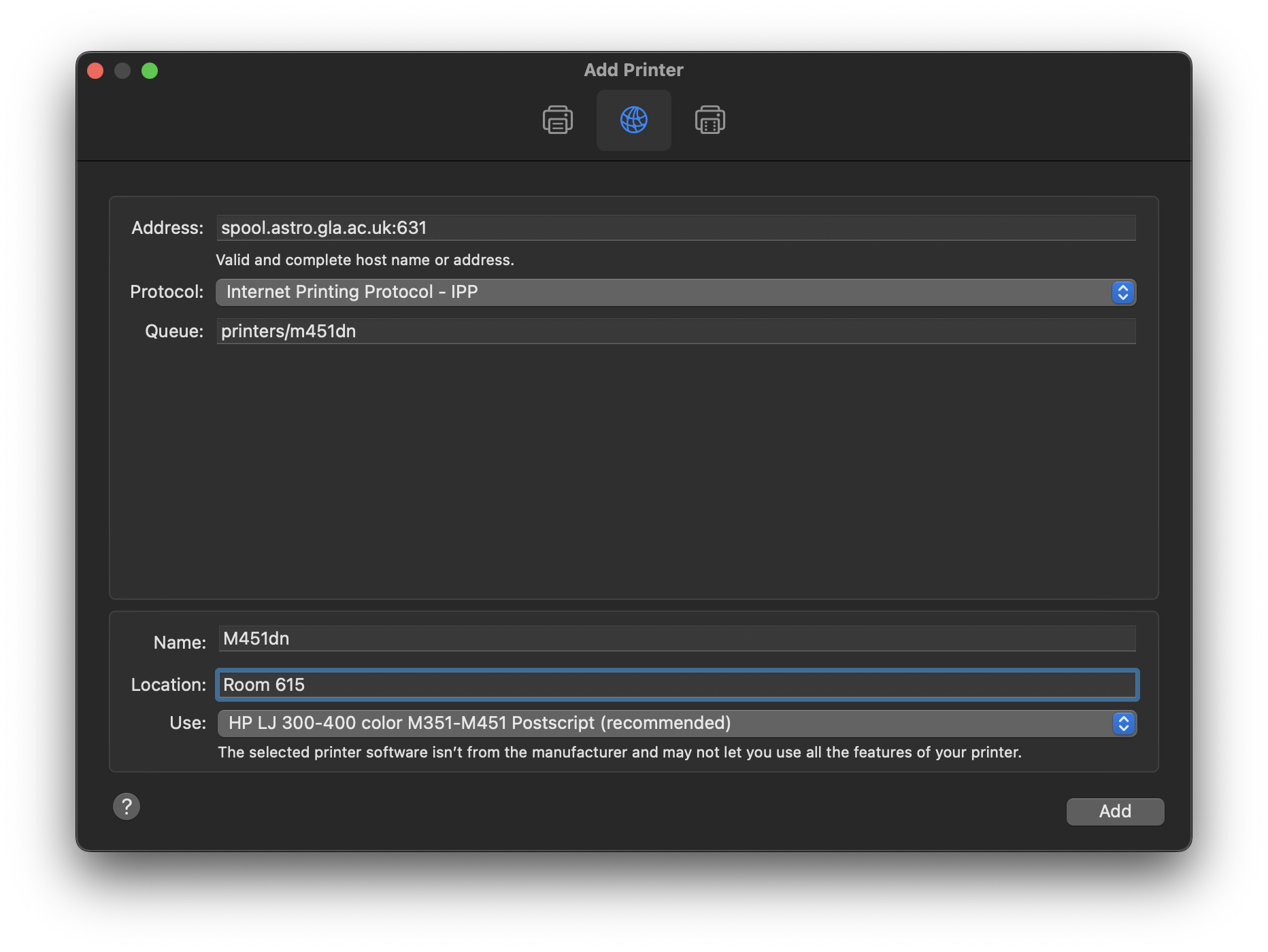
OS X seems to have a large number of printer drivers built-in, so that ‘Use’ and ‘Select Software...’ will allow you to identify a printer driver. See the printer list for the model numbers.
If you don't have the printer driver built in, then usually the `Generic PostScript Printer’ will work fine. If you have trouble, then you can find and install OS X printer drivers from Apple.
Local printers: Windows §
There are some instructions online for Windows 10.